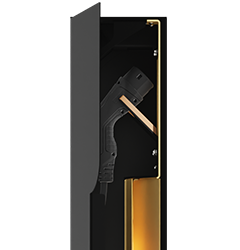
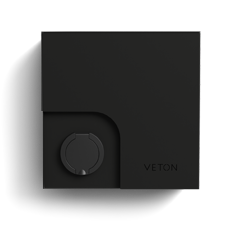
Extraordinary simplicity.

Wall brings premium charging quality to a compact wall-mounted solution. Discreet in design, powerful in performance.

veton wall hero
veton wall easy access

Easy access.

Wall combines premium charging performance with a sleek, compact wall design. Crafted from understated powder-coated steel, it is both discreet and stylish. Despite its modest size, Wall delivers up to 22 kW of charging power and comes standard with RFID and ISO15118 — future-ready for plug & charge and bidirectional charging.

A splash of color.

Available in four colors: Imperial Black, Cotton White, Midnight Blue and Medusa Green.

Pick a color

(RAL 9005)
veton website product one black thumbveton website product one white thumbveton website product one blue thumbveton website product one green thumb
veton wall black
veton wall rfid

Connectivity.

RFID is included as standard. Thanks to OCPP compatibility and integration with home automation and EMS platforms, Wall is highly versatile and ready for professional management and billing (via EV charging platforms).

Smart control.

Charge intelligently with Wall: integrate with solar panels, batteries, dynamic load balancing and tariffs. Fully compatible with KNX, Crestron, Loxone, Qbus and other EMS via Modbus, MQTT or REST API.

veton wall smart control
veton wall included veton one included mobile

How we keep fit.

Veton® uses a separate cabinet that houses the charging electronics and is installed indoors. Per charging point, the cabinet is equipped as standard with: a residual current circuit breaker, MID-certified meter, 6mA DC residual current monitoring module, power supply, Phoenix Contact CHARX controller, contactor, and grounding terminal. The cabinet is supplied in the size 450 × 315 × 155 mm (for a single charging point).

This setup makes the charging stations more compact and aesthetically refined, while the electronics are optimally protected against heat, cold, water, and sunlight. The result: durable reliability and an extended lifespan.

For integration with energy management systems or OCPP platforms, the cabinet is simply connected to the internet via a UTP cable.

So what's included?

Per Wall, in addition to the housing and charging components described above, the following are supplied as standard:
  • a charging port,
  • an integrated RFID reader,
  • a distribution block for connecting power and signal cables to the charging port and RFID reader, ensuring a clear and simple installation,
  • a Type A residual current circuit breaker.

What still needs to be provided?

Depending on the type of charging installation, the following must be supplied:
  • 5G 6mm² power cable,
  • CAT 7 SFTP data cable (x2) with 10 conductors in total.
veton wall included housing

Specifications.

connectivity

Connectivity

Ethernet, MQTT, Modbus TCP/RTU, REST API
Optional 4G/2G connection
charging specifications

Charging specifications

Mode 3 / 3,7 - 22 kW
3 x 400V+N / 16A - 32A per phase
overload protections

Overload protection

Dynamic load balancing
ocpp

EV charging platforms

Connect with provider of choice
via OCPP
energy monitor

Energy monitoring

MID certified energy monitor
Calculation of transaction costs
rcd

Residual Current Detection

Integrated in utility closet
6mA DC / 30mA AC
dimensions

Dimensions

350 x 350 x 136 mm
H x W x D
component housing

Component housing

Built-in utility closet
450 x 315 x 155 mm
cable

Cable

5G 6mm2 + 10 x 0.34mm2
(E)XVB + SFTP

FAQ

Design EV charger questions.

Answers for architects, homeowners and project teams comparing home EV chargers on durability, material quality and appearance.

Veton Wall has a Type 2 charging socket and delivers up to 22 kW on a 3×400 V installation. The user connects their own Type 2 cable. The socket version keeps the wall-mounted housing compact and avoids a permanently fixed cable, which is the right trade-off when the parking position is reliable and the user prefers to bring their own cable.

Most wallboxes are technical products with a neat casing. Veton is designed as an architectural outdoor object: freestanding or wall-mounted, material-led, visually calm and suited to high-end residential, hospitality and premium project environments.

For a serious shortlist, compare Veton, Smappee, Simpson & Partners, Andersen and Easee. They solve different design problems: architectural exterior object, energy-tech wallbox, quiet residential charger, customisable wallbox and compact minimalist charger.

Veton is available with premium exterior finishes including powder-coated steel, teak wood, Belgian blue natural stone and Carrara marble, depending on configuration and project requirements.

Yes. Veton One has been recognised by both the iF Design Award and the Red Dot Design Award, placing the brand in a product design context rather than only in the EV hardware market.

Look beyond charging power. Compare exterior materials, UV and weather resistance, cable management, repairability, how visible the charger is in the project, and whether the design still fits the building after several years.

Yes. Veton is designed for situations where charging is visible and must support the quality of the exterior environment, including high-end residential, hospitality, offices, premium SME parking and design-led developments.

Yes. Veton chargers expose a documented Modbus/TCP register map on port 502, so any EMS that speaks Modbus/TCP — Niko Home Control, Loxone, Qbus, KNX, Home Assistant, Xemex, LifePowr or a custom PLC — can read live charging data and write the target current. There is no cloud round-trip and no vendor lock-in. For sites without an EMS, Veton chargers also include built-in basic load management via the local web UI and mobile app, with optional dynamic balancing through an external grid meter or a Veton P1 module.

Yes. All Veton chargers are AC bidirectional ready and include the ISO 15118-20 hardware that Europe is standardising on through the AFIR regulation. The blocker today is regulatory, not technical — bidirectional approval still has to be obtained per EU country for each car-and-charger combination. Once the harmonised European framework lands (expected late 2026 / 2027), Veton installations can be activated for bidirectional charging via a software update, without changing the hardware.