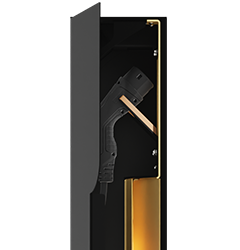
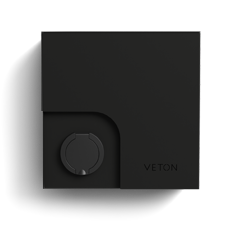
Charging masterpieces
Smart charging is inside every Veton® charger. No monthly fees. Built-in load management runs up to ten charge points. For larger sites, the Veton® load management device scales to 100+ points. OCPP-open. Works with Loxone, Niko, Qbus, KNX, Home Assistant and Crestron.
Plug in. The Veton® charger learns your week. It charges during the cheapest and sunniest hours. Tomorrow’s prices, the solar forecast. The car is ready when you leave. The plan is in the app.
Off, Fast, Solar and Smart, one tap from the home screen. Manual and Capacity under More modes. Pick the mode that fits the moment.
The Veton® app is the everyday remote: start and stop a session, follow energy live or over time, manage who can charge, and switch modes. It’s built around the idea that a charger should be easy to live with.
For apartment buildings, businesses and charging hubs, our load-management device runs 100+ charge points on a single site. It balances fairly across all three phases, adjusts capacity dynamically and factors in solar, so the site never exceeds its grid limit and every car charges as fast as fair sharing allows.
Veton® charges when energy is cheap and uses your own solar first. The savings report shows the result, measured against your real usage.
One dashboard for every Veton® charger. OCPP-open. Works with Loxone, Niko Home Control, Qbus and more. Use ours, use yours, or use both.
FAQ
How Veton chargers handle building capacity, solar, batteries and tariff prices — with built-in load management for simple sites and an open Modbus/TCP interface for projects that need a full energy management system.
Load balancing protects the building connection by adjusting the charging current in real time. Veton supports static balancing (a fixed maximum per charger) and dynamic balancing (the charger throttles when the rest of the building draws more). Up to 48 Veton charging points can be balanced as one group, with multiple groups possible on the same site.
Static balancing is enough for most single-charger residential sites with a comfortable connection margin. Dynamic balancing is the right choice when the connection is tight, when the building also runs a heat pump, HVAC, kitchens or batteries, or when several chargers share a single grid feed. Dynamic balancing needs a real-time view of the building consumption: this can come from an external grid meter (Carlo Gavazzi, Iskra, Inepro or Phoenix Contact EEM-series) or from a Veton P1 module that reads the digital meter directly via its P1 port — typically the simplest option in Belgium and the Netherlands, where the P1 port is standard on the smart meter.
Yes. With an external grid meter or an EMS that knows the solar production, the charger can be set to follow PV surplus — only consuming the kilowatts the panels are exporting. Below the 6 A minimum a single-phase EV will accept (~1.4 kW), the charger pauses and waits for production to come back up.
Veton chargers do not run their own day-ahead pricing logic — that decision belongs in the energy management system, which also sees the battery, heat pump and other flexible loads. EMS platforms can read live charging data over Modbus/TCP (port 502) and write the target current, charging hard during cheap or negative-price hours and pausing when prices spike.
Veton chargers ship with their own basic load management built in: static current limit per charger, group balancing across up to 48 points, mobile app and local web UI for control, and optional dynamic balancing via an external grid meter. This covers the majority of single-charger residential and small commercial sites without forcing a full EMS install.
Over Modbus/TCP. Each Veton charger exposes a documented register map on port 502: voltages, currents, power, energy, vehicle status (IEC 61851-1) and a writable max-current register. Any system that speaks Modbus/TCP — Niko Home Control, Qbus, Loxone, KNX, Home Assistant, Xemex, LifePowr or a custom PLC — can read live data and drive the charger natively, fully locally, with no cloud dependency.
Yes. Charging, load balancing and EMS logic run locally on the EV charger and (where present) on the local EMS. OCPP cloud platforms are used for billing, RFID authorisation and reporting, but the site keeps charging when the cloud is unavailable. This is the local-first design philosophy behind Veton.
Up to 48 Veton charging points can be controlled as a single group, and multiple groups can run side by side on the same site. The group automatically shares the available capacity between active sessions, prioritises connectors equally, and ramps power up and down as cars connect or disconnect.
Because the best charging decision depends on information the charger does not have: solar production, battery state, heat pump cycle, dynamic tariff, building connection limit, what the user wants by tomorrow morning. One system that sees all of it makes better decisions than five apps that each see one thing. Putting the EMS one layer above the charger keeps both layers clean.
Load balancing FAQ Vetonlm load management FAQ Solar EV charging FAQ Energy management & EMS Charging modes & the app Local OCPP, EMS and cloud Charging power and cables All FAQ topics
No matter the size of a project, our goal is to improve the general image of charging and driving electric vehicles, per big hub or single unit. Are you interested in working with Veton® chargers? Let us know.