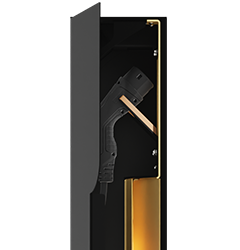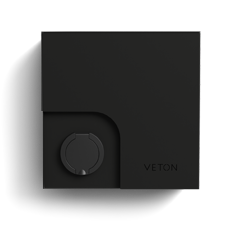

Slim laden zit in elke Veton®-lader. Geen maandelijkse kosten. Het ingebouwde laadbeheer stuurt tot tien laadpunten. Voor grotere sites schaalt het Veton® load management device naar 100+ punten. OCPP-open. Werkt met Loxone, Niko, Qbus, KNX, Home Assistant en Crestron.
Je lader, op zak.
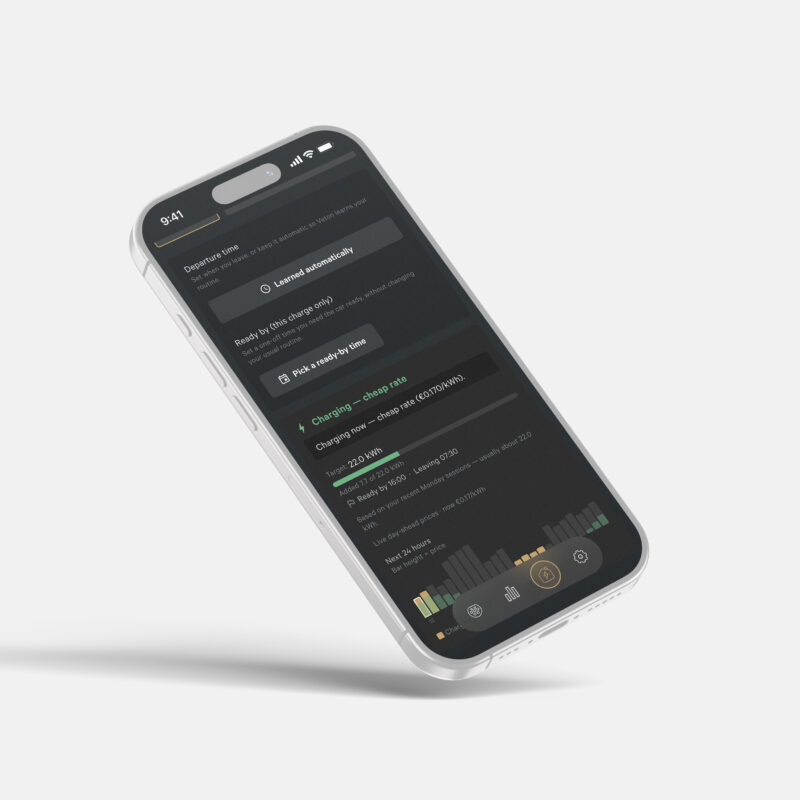
In de Veton®-app start en stop je sessies, volg je je verbruik in realtime of over de tijd, en bepaal je wie er mag laden of in welke modus. Het is wellicht de eenvoudigste lader om dagelijks mee te leven.
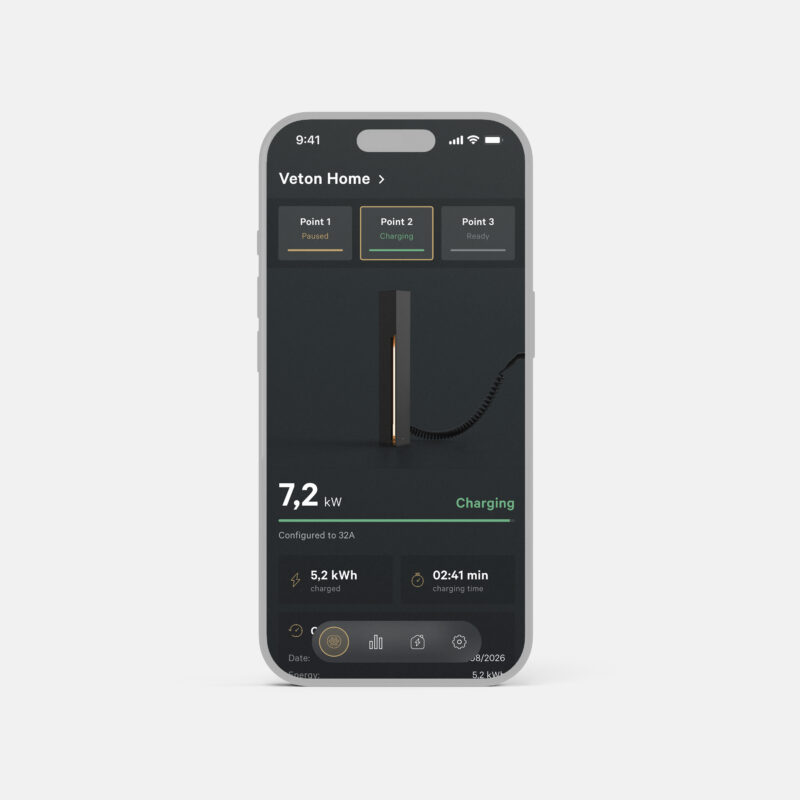
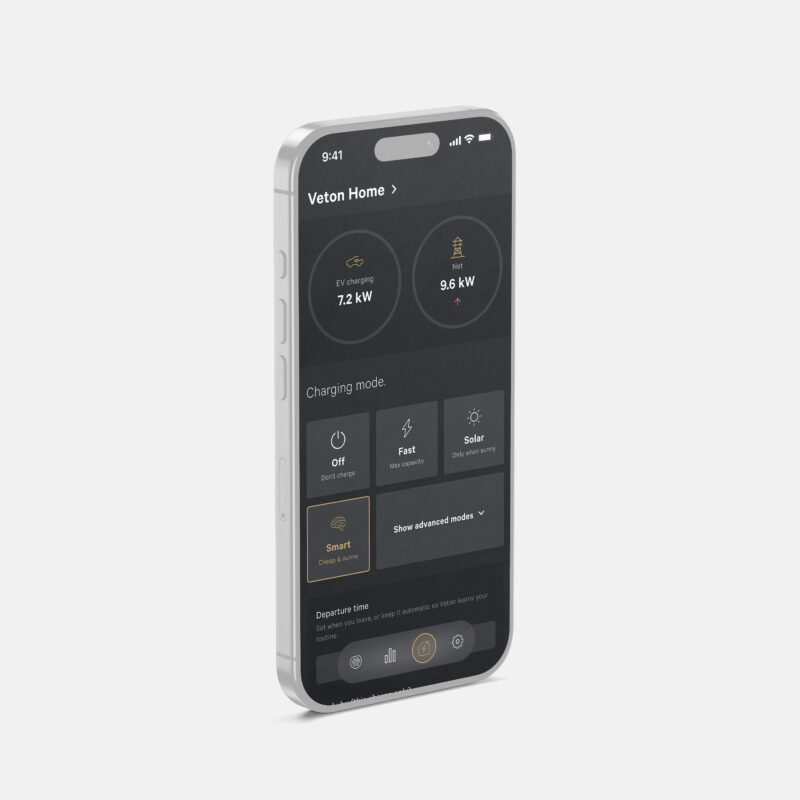
Kies hoe je laadt.
Off, Fast, Solar en Smart, één tik vanaf het startscherm. Manual en Capacity onder Meer modi. Kies de modus die bij het moment past.
Laden dat zichzelf plant.
Plug de wagen in en de lader leert vanzelf hoe je week eruitziet. Hij combineert de dagprijzen van morgen met de zonneprognose, zodat hij laadt wanneer stroom goedkoop of overvloedig is. ‘s Ochtends staat de auto klaar, en in de app zie je precies hoe de sessie verliep.
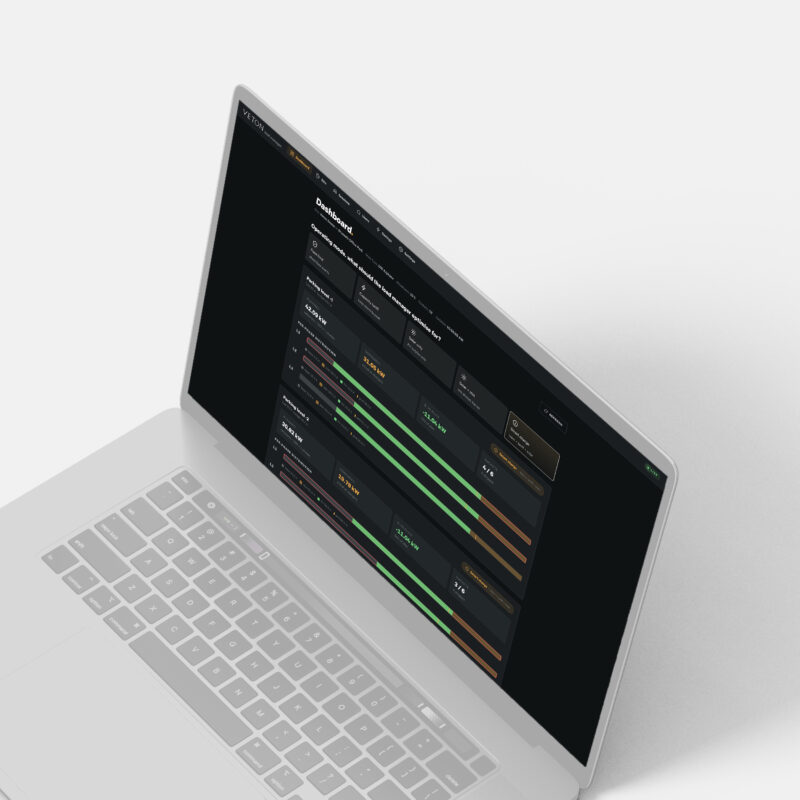
Energiebeheer voor grotere sites.
Voor appartementsgebouwen, bedrijven en laadhubs. Het Veton® load management device stuurt 100+ laadpunten op één site. Driefasige eerlijke verdeling. Dynamische capaciteit. Zonbewust. De hele site blijft binnen de netlimiet. Elke auto laadt zo snel als eerlijk kan.
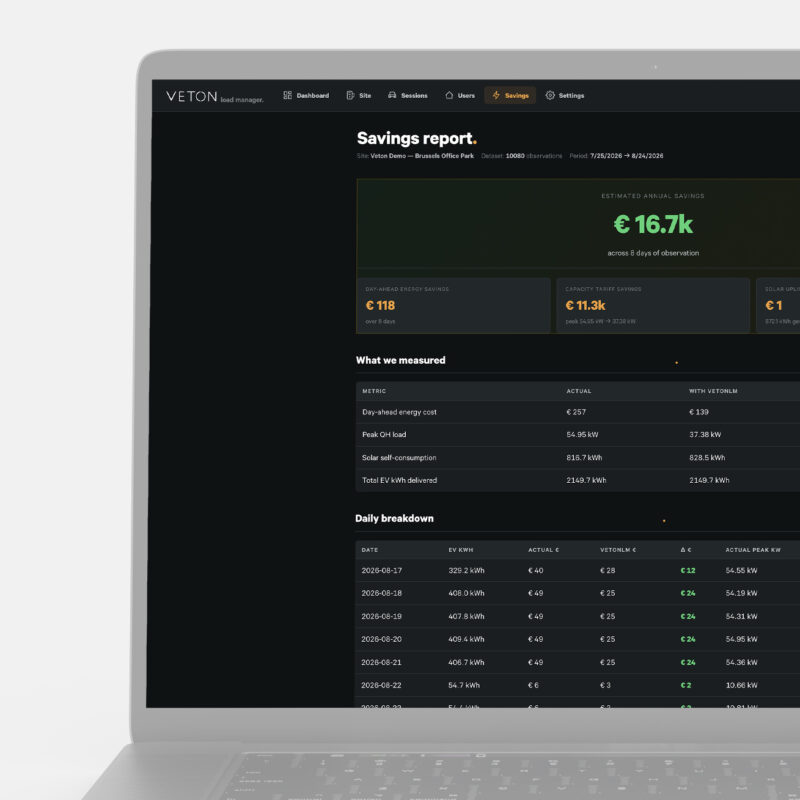
Zie precies wat je bespaart.
Veton® laadt wanneer energie goedkoop is en gebruikt eerst je eigen zon. Het besparingsrapport toont het resultaat, gemeten tegenover je werkelijke verbruik.
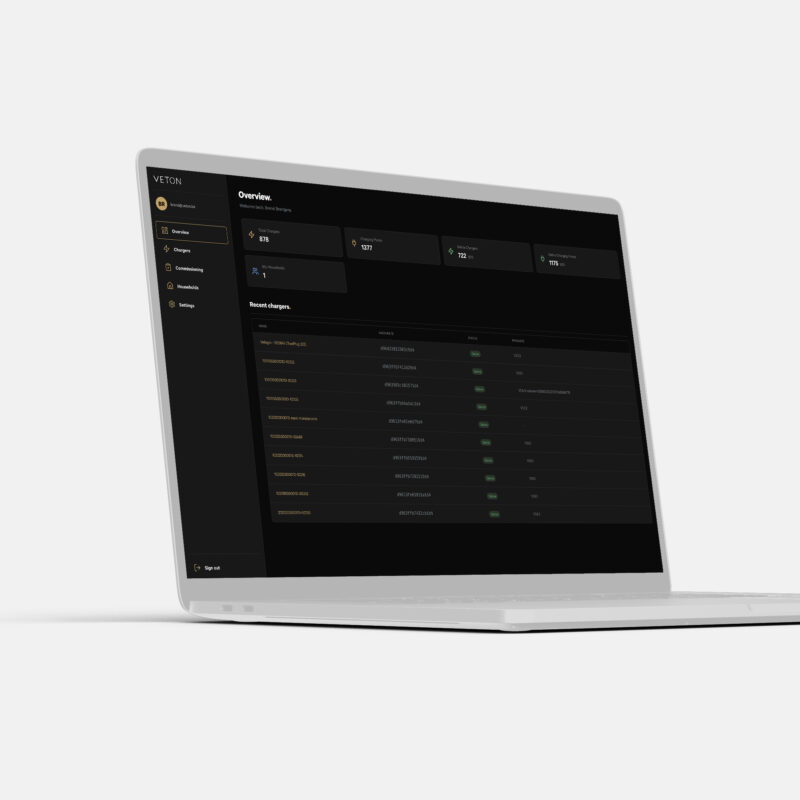
Open van opzet, van één lader tot een vloot.
Eén dashboard voor elke Veton®-lader. OCPP-open. Werkt met Loxone, Niko Home Control, Qbus en meer. Gebruik die van ons, die van jou, of allebei.
EMS systemen.
















FAQ
Load balancing & energiebeheer vragen.
Hoe Veton-laadpalen omgaan met de gebouwcapaciteit, zon, batterijen en dynamische tarieven — met ingebouwd lastbeheer voor eenvoudige sites en een open Modbus/TCP-interface voor projecten met een volwaardig energiebeheersysteem.
Load balancing beschermt de aansluiting van het gebouw door de laadstroom in realtime aan te passen. Veton ondersteunt statische balancering (een vast maximum per laadpaal) en dynamische balancering (de laadpaal schakelt terug wanneer de rest van het gebouw meer trekt). Tot 48 Veton-laadpunten kunnen als één groep gebalanceerd worden, met meerdere groepen mogelijk op dezelfde site.
Statische balancering volstaat voor de meeste residentiële sites met één laadpaal en voldoende reservecapaciteit. Dynamische balancering is de juiste keuze wanneer de aansluiting krap is, wanneer er ook een warmtepomp, HVAC, keukens of batterijen draaien, of wanneer meerdere laadpalen één voeding delen. Dynamische balancering heeft een realtime beeld van het gebouwverbruik nodig: dat kan komen van een externe nettmeter (Carlo Gavazzi, Iskra, Inepro of Phoenix Contact EEM-reeks) of van een Veton P1-module die de digitale meter rechtstreeks uitleest via de P1-poort — meestal de eenvoudigste optie in België en Nederland, waar de P1-poort standaard op de slimme meter zit.
Ja. Met een externe nettmeter of een EMS dat de zonneproductie kent, kan de laadpaal de PV-overschotstroom volgen — enkel de kilowatts opnemen die de panelen exporteren. Onder de 6 A-minimumstroom die een eenfase EV accepteert (~1,4 kW) pauzeert de laadpaal tot de productie weer toeneemt.
Veton-laadpalen draaien zelf geen day-ahead prijsraadpleging — die beslissing hoort thuis in het energiebeheersysteem, dat ook de batterij, warmtepomp en andere flexibele lasten ziet. EMS-platformen kunnen via Modbus/TCP (poort 502) live laaddata uitlezen en de doelstroom wegschrijven: hard laden tijdens goedkope of negatieve uren, pauzeren bij piekprijzen.
Veton-laadpalen hebben hun eigen basis lastbeheer ingebouwd: statische stroomlimiet per laadpaal, groepsbalancering tot 48 punten, mobiele app en lokale web-UI voor bediening, en optionele dynamische balancering via een externe nettmeter. Dat dekt de meerderheid van de residentiële sites en kleinere commerciële sites zonder dat een volwaardig EMS hoeft geïnstalleerd te worden.
Via Modbus/TCP. Elke Veton-laadpaal stelt een gedocumenteerde registermap beschikbaar op poort 502: spanningen, stromen, vermogen, energie, voertuigstatus (IEC 61851-1) en een schrijfbaar max-stroomregister. Elk systeem dat Modbus/TCP spreekt — Niko Home Control, Qbus, Loxone, KNX, Home Assistant, Xemex, LifePowr of een custom PLC — kan live data uitlezen en de laadpaal rechtstreeks aansturen, volledig lokaal en zonder cloudafhankelijkheid.
Ja. Laden, load balancing en EMS-logica draaien lokaal op de laadpaal en, indien aanwezig, op het lokale EMS. OCPP-cloudplatformen worden gebruikt voor facturatie, RFID-autorisatie en rapportering, maar de site blijft laden als de cloud onbereikbaar is. Dat is de local-first-filosofie achter Veton.
Tot 48 Veton-laadpunten kunnen als één groep aangestuurd worden, en meerdere groepen kunnen naast elkaar draaien op dezelfde site. De groep deelt de beschikbare capaciteit automatisch tussen actieve sessies, behandelt connectoren gelijk en regelt het vermogen op of af naarmate auto's aankoppelen of vertrekken.
Omdat de beste laadbeslissing afhangt van informatie die de laadpaal niet heeft: zonneproductie, SoC van de batterij, warmtepompcyclus, dynamisch tarief, aansluitlimiet, om hoe laat de wagen morgen klaar moet staan. Eén systeem dat alles ziet, neemt betere beslissingen dan vijf apps die elk één ding zien. Het EMS één laag bóven de laadpaal plaatsen, houdt beide lagen zuiver.
Load balancing FAQ Vetonlm load management FAQ Zonne-laden FAQ Energiebeheer & EMS Laadmodi & de app Lokaal OCPP, EMS en cloud Laadvermogen en kabels Alle FAQ-onderwerpen