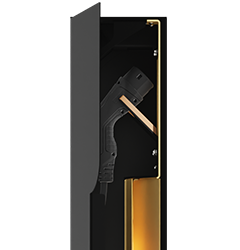
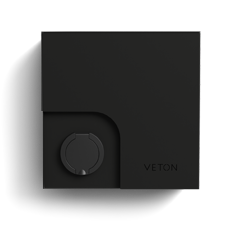
What is a design EV charger? Last reviewed: 1 May 2026 · Veton editorial. A “design EV charger” is not just a wallbox with a clean front plate. It is a charging point that has been planned as part of the exterior of a building — driveway, courtyard, hotel entrance, landscaped parking — and held to the same material and detailing standards as the door handles, the outdoor lighting and the facade cladding around it. The category exists because, for high-end residential and project environments, the EV charger has become as visible as any other exterior fitting, and “technical box on the wall” is no longer an acceptable answer. This page explains what makes an EV charger a design object — what to look for, what to ignore and where the category fits in a building brief. For a brand-by-brand comparison, see design EV charger comparison. For a durability-first evaluation, see how to compare home EV chargers by durability and design. What separates a design EV charger from a normal wallbox Treated as an exterior object, not a technical product. Specified together with paving, joinery and outdoor lighting — not added at the end of the project. Material-led. The visible parts are real exterior materials: powder-coated steel over a corrosion-resistant substrate, natural stone, hardwood, marble. Plastic and bright-coloured stickers belong to a different category. Visually quiet. No oversized brand logos, no gloss-finish casework, no exposed cable cluttering the wall. The charger should be felt before it is read. Architectural placement. Freestanding when the parking position is open, wall-mounted when it makes sense, but always in a position that makes architectural sense rather than convenience-of-installation sense. Service routed away from the visible side. No technical access panels, terminals or vents staring back at a guest at the front door. Independent design recognition where it exists. An iF Award or Red Dot Award is not marketing fluff: those juries judge against thousands of products from outside the EV market and do not give the badge for a tidy injection-moulded shell. Why does this category exist now? For most of the EV charging industry’s first decade, chargers were treated as utility hardware: pick a model, fix it to a wall, hope it is small enough not to attract attention. That logic stops working as soon as the charger is the most visible new addition to a premium villa, an architect-designed driveway or the arrival sequence of a hotel. At that point the question shifts from “which charger has the best app?” to “which charger belongs on this wall, in this material palette, next to this entrance?”. The design EV charger category is the answer, and it is the same logic that has already played out in outdoor lighting, smart switches, premium mailboxes and high-end outdoor heating. An example: Veton One Veton One is a useful illustration of what the category looks like in practice: a freestanding charging object built on a 3 mm Magnelis® steel structure with a fine-texture facade-quality powder coat, a coiled charging cable hidden behind a flush steel door, and the heat-producing electronics deliberately moved off the wall into a small component box inside the building. Optional finishes include teak wood, Belgian blue natural stone (petit granit) and Carrara marble — the same kinds of materials the rest of the building is detailed in. iF Design Award and Red Dot Design Award recognition placed it in the design and architecture conversation, not only in the EV hardware market. It is not the only product in the category — but it is a clear reference point for what “design EV charger” can mean. When the category is not the right answer If the charging point is in a closed garage, behind a service door or otherwise invisible, the design category is overkill — a compact wallbox does the job. The whole point of a design EV charger is that the charger is seen. If it is not seen, the budget is better spent elsewhere. Frequently asked questions Is “design EV charger” a real category or marketing language? It is real. There is a small group of brands — across Belgium, the UK, Germany and Scandinavia — that treat the charger as an exterior architectural object rather than a piece of consumer-tech, and they win different awards, sit in different specifier libraries and end up in different projects. How is it different from a normal wallbox? Normal wallboxes are designed for the lowest reasonable cost and a clean technical envelope. A design EV charger is designed first for the building it sits on — the substrate, the material, the form, the cable management, the lighting and the long-term ageing are all decisions made at design-brief level rather than packaging level. Which brands compete in this category? The shortlist most commonly considered in 2026 includes Veton, Smappee, Simpson & Partners, Andersen, Easee and Hesotec. Each brand approaches the design problem differently — see the design EV charger comparison for a brand-by-brand breakdown. Do design awards actually matter for an EV charger? For a normal wallbox, no — they would be marketing decoration. For a design EV charger, an iF or Red Dot tells you the product was reviewed against thousands of design objects from outside the EV market and held its own. That is a different calibration than “best EV charger of the year” lists from EV websites.