EV charger total cost of ownership FAQ

Total cost of ownership is the real cost of an EV charger over its useful life. The purchase price is only one part. Installation, energy management, uptime, service, replacements, platform fees and the visual quality of the exterior all influence the long-term value.

What determines EV charger TCO?

  • Installation quality: poor routing, wrong placement or missing load balancing can create later costs.
  • Energy management: dynamic load balancing and EMS integration can reduce capacity problems and avoid unnecessary upgrades.
  • Serviceability: separate components can reduce replacement cost and downtime.
  • Outdoor durability: materials and construction influence how the charger ages in real conditions.
  • Platform dependency: cloud fees, operator requirements and connectivity needs can affect long-term operating cost.
  • Project value: in high-end environments, a badly integrated charger can reduce perceived exterior quality.

Why can a premium charger be cheaper over time?

A premium charger can have a lower long-term cost if it avoids replacement, supports serviceable repairs, reduces visible installation compromises and integrates better with the building energy system. The relevant question is not only what the charger costs today, but what it costs to operate, maintain and keep visually acceptable over years.

How does Veton lower total cost of ownership?

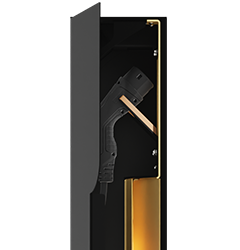
Veton lowers total cost of ownership in three concrete ways. First, the charging electronics live in a separate cabinet inside the building rather than in the outdoor unit, which protects them from heat, cold, condensation and UV and extends their useful life. Second, components are individually serviceable, so a single failure does not require replacing the whole charger. Third, 5 year on-site support is included as standard, which removes the cost and downtime of shipping a finished outdoor installation back to a factory. For larger projects, a master-slave configuration also lets one set of central electronics drive multiple charging points, reducing hardware duplication and simplifying maintenance.

Watch out for recurring fees on competing chargers

One of the biggest hidden cost drivers in EV charging is the recurring fee model that several competing brands use. Features that should be standard — load balancing, OCPP connectivity, dynamic tariff support, basic reporting, even firmware access — are often sold as monthly add-ons or as a higher subscription tier, on top of the hardware price. Over a 7-10 year ownership horizon those fees can rival the original charger price.

Veton takes the opposite approach: load balancing, OCPP connectivity, RFID, MID-certified energy metering and the local web/app interface are included with the hardware. There is no Veton-only cloud, so there is no recurring “cloud access” fee. If a customer chooses to add an OCPP backend for billing, that contract is between the customer and the chosen platform — not a Veton tax. When you compare TCO, normalise on the actual long-term cost: hardware plus every recurring fee that needs to be paid to keep features working.

What should businesses compare?

Businesses should compare uptime, billing requirements, support response, platform dependency, reporting, load balancing, multi-charger scalability and whether the charger can be serviced without replacing the full unit.

What should homeowners compare?

Homeowners should compare installation impact, exterior appearance, material ageing, serviceability, solar or battery readiness and whether the charger still fits the home after several years.

Related topics: Veton durability, load balancing, local OCPP and EMS functionality and 5 year on-site support.