EV charging for hospitality FAQ

Hotels, restaurants, resorts and premium hospitality venues need EV charging that supports the guest experience. The charger should be reliable, easy to use, visually calm and aligned with the quality of the arrival zone — and it should let the operator decide between a free guest amenity, a paid service or both, without locking the venue into a single vendor cloud.

Key questions

What matters most for hospitality charging?

Guest clarity, uptime, access control, billing or free-use policy, cable management and visual integration all matter. The charger is part of the first impression of the venue, alongside the entrance lighting, signage and landscaping. A technical-looking white plastic wallbox in a stone-and-teak arrival zone is rarely the right answer.

Which Veton models suit hospitality best?

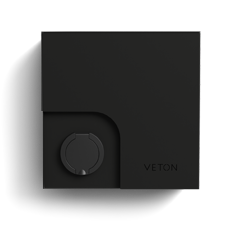
  • Veton Two (socket) — two concealed Type 2 sockets, up to 22 kW each. Guests connect their own Type 2 cable; both cars can charge simultaneously. The minimal external appearance suits arrival courtyards and porte-cochère positions.
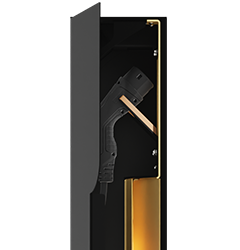
  • Veton One or Two (plug) — for venues that prefer to remove the cable question from the guest entirely; the charging cable is integrated and hidden behind a steel door, ready for any Type 2 vehicle.
  • Veton Ili — companion outdoor light that shares the materials and design language, so a multi-charger arrival zone reads as one coherent composition.

All variants are built on a 3 mm Magnelis® steel structure with a facade-quality powder coat, rated IP65 / IK10 for outdoor exposure in real arrival-zone traffic.

Should hospitality chargers be public or private?

That depends on the business model. Some venues offer charging as a free guest amenity (a stay incentive), others charge for it (separate revenue stream), and many use a hybrid — free for resident guests, paid for non-residents.

  • Free amenity, no platform required: the venue manages access through RFID cards issued at check-in and uses the Veton mobile app to monitor live status and per-session energy. CSV export is available if internal accounting wants the kWh totals.
  • Paid charging via OCPP: the chargers connect to the OCPP platform of the venue’s choice — see the EV charging platforms overview for a list of platforms used in real Veton projects. The platform handles tariffs, invoicing, eMSP roaming and reporting.
  • Hybrid: RFID whitelist for resident guests, OCPP-authorised charging for visitors.

Why does design matter in hospitality?

In hospitality, the charger is part of the arrival experience. A technical-looking charger reduces the perceived quality of the entrance, while a well-integrated charger supports the broader design language. For premium hotels and restaurants, this is the same logic as choosing the door handles, the signage and the courtyard lighting — small surfaces with disproportionate impact on the brand.

See also OCPP and charging platforms FAQ, billing and reimbursement FAQ, the EV charging platforms overview and design EV charger comparison.