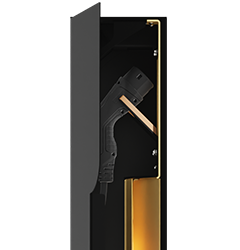
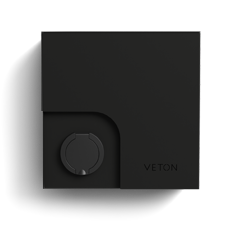
EV charger materials FAQ Materials define how an EV charger looks, ages and belongs in the exterior. For high-end residential and project environments, material choice is not decoration — it is part of the architectural brief, and the substrate behind the visible finish is what determines whether the charger still looks intentional in five or ten years. Key questions Why do EV charger materials matter? Outdoor chargers face UV, rain, frost, salt, impact and daily contact. Materials shape the first impression of the driveway, garden or entrance, and they determine how the charger ages. A premium charger should age coherently with the building and landscape — not yellow, fade, rust or chip after a few seasons. What is the Veton charger built from? Every Veton charger uses a 3 mm Magnelis® steel frame with 2 mm Magnelis® outer panels, finished with a fine-texture facade-quality powder coat. Magnelis® is a metallic coating developed by ArcelorMittal that combines zinc with about 3.5 % aluminium and 3 % magnesium, giving it markedly better corrosion resistance than standard hot-dip galvanised steel and — critically — a self-healing behaviour: when the surface is scratched or cut, the coating reacts with moisture to form a stable protective layer over the exposed steel, so a small scratch does not turn into red rust over time. It is the same coating used in agricultural buildings, road infrastructure and exposed solar mounting systems for exactly that reason. Why Magnelis® instead of galvanised or stainless? Standard hot-dip galvanised steel protects the surface but fails at cut edges and scratches. Stainless steel is corrosion-resistant but expensive, heavy and visually cooler than most architectural exteriors require. Magnelis® on a 3 mm steel frame gives the structural rigidity of mild steel, the long-term corrosion behaviour of a high-grade coating and a substrate that can be powder-coated in any RAL colour or carry a stone, wood or marble cladding without compromising the metal underneath. Which finishes are available? Powder-coated steel — fine-texture facade-quality lacquer over Magnelis®. Standard colours: Imperial Black (RAL 9005), Cotton White, Midnight Blue and Medusa Green. Any custom RAL or branded front plate is available on request. Teak wood — premium exterior teak cladding, ages naturally to a silvered grey or kept warm-brown with periodic teak oil. Belgian blue natural stone — petit granit, a regionally quarried limestone with deep grey tone and dense fossil texture, frequently used in Belgian architectural projects. Carrara marble — Italian white marble with characteristic veining, suited to high-contrast exteriors. The Veton Ili outdoor light is built to the same materials brief and uses the same finish range, so a charger and its surrounding lighting can read as one composition rather than two unrelated products. How should architects select a finish? Start from the building palette: facade, joinery, paving, outdoor lighting, landscape materials and hardware. The charger can either quietly blend in (matched powder coat, dark RAL, stone matched to paving) or become a controlled design accent (Carrara marble against a dark facade, teak against rendered white). Sample tiles for stone, wood and powder-coat finishes can be reviewed before specifying. See also weather resistance FAQ, maintenance FAQ, what is a design EV charger? and durability & design comparison.