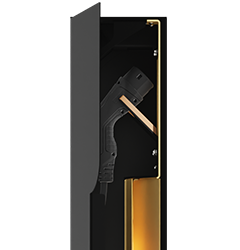
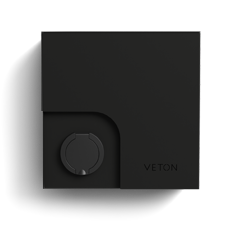
EV charger weather resistance FAQ Outdoor EV chargers must handle real exterior conditions: rain, UV, frost, heat, dust, salt air, impact risk and daily use. Weather resistance is a combination of the IP and IK ratings, the substrate behind the visible finish, and where the heat-producing electronics actually live. Key questions Can a Veton charger be installed outside? Yes — Veton is designed as an architectural outdoor object. The charging point itself carries IP65 (full protection against dust ingress and against low-pressure water jets from any direction) and IK10 (the highest impact rating in the IEC standard, equivalent to a 5 kg mass dropped from 400 mm). It is rated for outdoor installation in residential, hospitality and commercial environments. Where do the electronics actually live? Inside the building, in a separate component box. The outdoor charging object holds the charging interface and connectors; the controllers, protection devices and sensitive electronics sit indoors in a small distribution box. This is the most important difference between Veton and a typical sealed wallbox: the parts that age fastest under outdoor heat, UV and condensation are not exposed to those conditions in the first place. Is the IP rating the only durability factor? No. IP65 keeps water and dust out of the housing today, but long-term outdoor quality also depends on the substrate, the coating, the construction, exposure and maintenance. Veton uses a 3 mm Magnelis® steel frame with 2 mm Magnelis® outer panels under a facade-quality powder coat. Magnelis® (zinc + ~3.5 % aluminium + 3 % magnesium) is self-healing on cut edges and scratches: when the surface is damaged, the coating reacts with moisture to form a stable protective layer over the exposed steel, instead of allowing red rust to spread under the paint. That is the kind of detail that decides how a charger looks five years in, not five days in. What about extreme temperatures? The charging object outside has no power electronics that suffer from thermal cycling — those live indoors in a controlled environment. The mechanical exterior is rated for European outdoor temperature ranges including frost and direct summer sun. In coastal or industrial environments where salt air or chemical fallout is a concern, the Magnelis® substrate is one of the reasons Veton handles the exposure better than a powder-coated mild-steel charger that relies on the paint alone. What should premium projects consider? Plan exposure and visual ageing together: where will the charger sit relative to prevailing rain and sun, will rain run cleanly off the housing, will paving splash dirt against the lower panels, can the door and the cable compartment be opened cleanly without tools? On a Veton site this is mostly a positioning question — the materials and the architecture of the product already do the heavy lifting. See also materials FAQ, maintenance FAQ, Veton durability FAQ and durability & design comparison.