Charging power and cables FAQ

Veton makes deliberate choices about charging power, cable type and connector design. The defaults are based on real-world residential and project use, where comfort, durability and visual quality matter as much as headline kilowatts. This FAQ explains the reasoning so installers, architects and homeowners can match the right configuration to the project.

Key questions

What is the maximum charging power of the integrated cable on Veton?

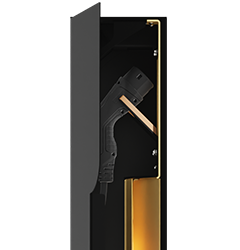
The default integrated cable on Veton One, Veton Two (plug) and Veton Wall Plus is a 20 A, three-phase coiled cable. On a three-phase 400 V installation, that delivers up to about 13.8 kW. The cable is comfortable to use up to roughly 4 metres from the charger and stays neatly hidden behind a steel door when not in use.

Why doesn’t Veton use a 32 A, 22 kW integrated cable by default?

A 32 A three-phase cable is significantly heavier and stiffer than a 20 A cable. For a residential or hospitality user who plugs and unplugs daily, that weight difference matters more than the headline power figure. Veton prioritises user comfort over spec-sheet chasing. In addition, most electric vehicles still cannot accept more than 11 kW on AC charging, so a 22 kW cable rarely delivers more useful power than a 13.8 kW cable. At 13.8 kW, a typical EV battery is fully charged overnight, which is what residential and hospitality use cases actually need.

Can I still get 22 kW with Veton?

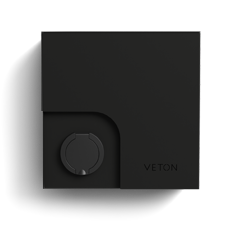
Yes. All Veton chargers with sockets — Veton Two (socket), Veton Two (base) and the socket versions of Wall and Wall Plus — deliver 22 kW per socket on a 3×400 V installation. The user supplies their own Type 2 cable in that case. For higher power on an integrated cable, only Veton Wall Plus also offers straight 32 A cables (monophase and three-phase) on request as an alternative to the default 20 A coiled cable. Veton One and Veton Two (plug) keep the 20 A coiled cable as the integrated option, with a 32 A monophase cable available on request when the site is on a monophase or 3×230 V supply.

What about monophase or 3×230 V installations?

For sites that have a monophase or 3×230 V supply rather than a 3×400 V network, a 32 A monophase cable is available on request. This delivers a similar real-world charging speed as the default 20 A three-phase cable on suitable installations, and avoids the limits of a low-amp monophase setup.

What cable options are available on Wall Plus?

Veton Wall Plus comes by default with the same 20 A three-phase coiled cable as Veton One — usable up to about 4 metres, 13.8 kW maximum on 3×400 V. For projects that prefer a longer reach or different power profile, Wall Plus is also available with straight cables in different lengths and amperages, including 32 A monophase and 32 A three-phase options.

How does Veton’s cable choice affect everyday use?

The coiled 20 A cable is light enough to handle with one hand, retracts neatly behind a steel door and reaches up to 4 metres in daily use. Combined with 13.8 kW of charging power, it covers a typical residential or hospitality charging need without the bulk and stiffness of a 32 A cable. The result is a charging experience that fits a premium architectural environment, where the charger is visible and used every day.

Which configuration is right for my project?

  • Single residential car, 3×400 V: default 20 A coiled cable, 13.8 kW. Best comfort, full overnight charging.
  • Multi-vehicle household or fleet, AC-only EVs at 22 kW: socket models (Veton Two, Wall socket) at 22 kW, with the user’s own cable.
  • Monophase or 3×230 V supply: 32 A monophase cable on request.
  • Hospitality or premium parking with predictable cable handling: default 13.8 kW coiled cable for guest comfort.
  • Specific 22 kW with integrated cable: 32 A three-phase straight cable on request.

For practical placement of the cable and charger position, see the EV charger installation FAQ. For broader comparison and product positioning, see the design EV charger comparison.