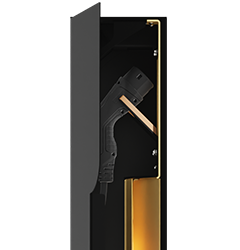
EV charger installation FAQ Installation determines whether a premium EV charger looks intentional, works reliably and remains serviceable. For Veton projects, the technical installation should be planned together with the visual position of the charger, cable routing, parking movement and future maintenance access. Key questions Where should an EV charger be placed? Place the charger where the car naturally parks, the cable can reach without crossing walking routes, and the charger fits the exterior composition. In premium projects, the charger should be positioned like an architectural object rather than added after the driveway is finished. Do I need an installer? Yes. EV charging requires a qualified installer who can check the electrical capacity, protection, earthing, cable section, load balancing requirements and local compliance. Veton can help connect projects with an expert through the Find an expert page. How long is the integrated charging cable on Veton One and Two? Veton One and Veton Two (plug) use a coiled, integrated charging cable that stays neatly hidden behind a steel door when not in use. The cable is comfortable to use up to about 4 metres from the charger, which is enough to reach the charging port of a car parked in a typical residential or hospitality position. When parking layout, vehicle orientation or driveway geometry vary, plan the charger position so the car’s charging port lands within that 4-metre working radius. How are Veton chargers wired? Veton separates the electronics from the charger itself. Inside the building, a small enclosure — the component box (a compact distribution box with the breakers and control electronics) — sits in the technical room or close to the main panel. The charger outside stays a clean architectural object: no visible electronics, no large terminal compartment to access for service. The installer brings power and network to the indoor component box. From there, dedicated cables run out to each charger. Cabling between component box and charger 1 × power cable per charging point — typically 5G6 (5 conductors, 6 mm²) or equivalent, sized for the protection rating and run length. 1 × network cable per charging point — Cat6a or Cat7, used for control and communication between the component box and the charger. Maximum run: 100 m between component box and charger. For a double charger (Veton Two plug, Two base), this means 2 power cables and 2 network cables — one set per charging point. Exceptions Veton Two (socket): 2 power cables and 3 network cables from the component box to the charger. Veton Wall Plus (socket version): single charging point, but 1 power cable and 2 network cables from the component box to the charger. Plan the conduit cross-section for these counts at the time the foundation or wall opening is prepared, so cables do not need to be re-routed later. The exact wire sizes and breakers depend on the chosen charging power, the run length and local code, and should be confirmed by the installing electrician. What should be prepared before installation? Parking position and charging cable reach (around 4 metres for integrated-cable models). Indoor location for the Veton component box, with power and network feeds. Conduit route between component box and charger (max 100 m), with the right number of power and network cables for the chosen model. Electrical capacity and load balancing requirements. Foundation or wall mounting position. Network or platform requirements if connected charging is needed. Material finish and visual alignment with the exterior. For related technical topics, see load balancing & energy management, energy management & EMS integration, EV charging platforms and downloads.