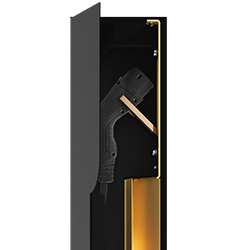
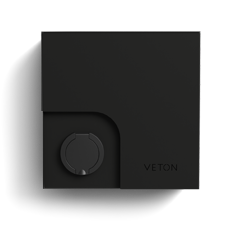
Dual charging FAQ A dual charger puts two charging points in one housing, for a home with two cars, a business with a small fleet, or a car park with more than one user. This page answers the questions that come up most: whether one charging point can serve two cars, whether two separate chargers are needed, how load balancing works between the two points, and which Two variant fits which situation. Can one charging point charge two cars at the same time? No. One charging point serves one socket or one cable, and so one car at a time. Two cars charging together need two charging points. Veton® Two delivers those two points in one housing: a double socket, two Type 2 sockets, on Two (socket) and Two (base), or two integrated cables on Two (plug). Each of the two points has its own MID-certified meter and its own Phoenix Contact CHARX controller, and both can charge at once, independently of each other. Do I need two separate chargers for two cars, or does one Two cover it? Two cars need two charging points, not two chargers. Veton® Two bundles both into one architectural object, not two boxes on the wall or two posts on the driveway. Priced per point, Two lands close to what a mainstream dual charger costs per point: split a design charger’s premium across two points instead of one, and it mostly disappears. Veton doesn’t publish prices online. An approved installer quotes the project from a photo of the site. Does load balancing work between the two points of a Two? Yes, and it runs automatically. Both points on a Two can charge at once, and dynamic load balancing adjusts the power at each one in real time as the building’s available capacity changes. That’s the same load balancing built into every Veton® charger, no extra cost, no monthly subscription. Some competing dual chargers can’t balance their two points against each other. Others charge a recurring software fee for it. Do I need 11 kW or 22 kW for a dual charger? Most electric cars don’t accept more than 11 kW on AC charging anyway, which makes the choice less critical than it looks. Two (socket) and Two (base) deliver up to 22 kW per socket on a 3×400 V installation, with the driver’s own Type 2 cable. Two (plug) delivers up to 13.8 kW per integrated cable, enough to fully charge most cars overnight. Anyone ruling out a future car with higher AC acceptance should pick a socket variant. Two (socket), Two (plug) or Two (base): what is the difference? All three variants share the same housing, the same materials and the same two charging points. Two (socket) has two Type 2 sockets and a vertical LED, for drivers who bring their own cable. Two (plug) replaces the sockets with two integrated cables, each tucked behind its own steel door, so nothing is left lying around after charging. Two (base) is the socket version without the LED strip: a plainer build aimed at business sites and car parks. Does a dual charger have a MID-certified meter? Yes, one per charging point. Each of the two points on a Two has its own MID-certified meter, alongside its own residual current circuit breaker, a 6mA DC residual current monitoring module and a Phoenix Contact CHARX controller, all inside the indoor cabinet. A MID meter is what makes charging costs demonstrably billable, for example between employer and employee, landlord and tenant, or through an OCPP billing platform. Is a dual charger suitable for businesses or multi-user buildings? Yes. Two (base) is built specifically for business sites and car parks: an all-steel housing with no LED accent, with the same two charging points as the other Two variants. For access control across multiple users, every Veton® charger supports a local RFID whitelist, and for billing or per-user reporting, the charger connects to the OCPP platform of your choice. Sites with more than two charging points, such as an apartment building, a depot or a car park with several Two units side by side, scale through the Veton load management device to more than 100 charging points, with the same fair-share split of power across phases and chargers. Does a dual charger need a heavier grid connection? Two charging points draw the same power whether they sit in one housing or two: the number of cars that can charge at once sets the demand, not the shape of the cabinet. What a Two does bring is load balancing built into both points by default. Fuse protection is always on, splits the available power fairly between the two points, and pulls back the moment the rest of the building draws more. On the connection itself, the cabling, or any groundworks, Veton makes no claim here: an approved installer decides that based on the actual site, not a general rule. More on the three variants: Two (socket), Two (plug) and Two (base). For how load balancing works more broadly, see the load balancing FAQ, and for the full cost picture, the EV charger total cost of ownership FAQ.