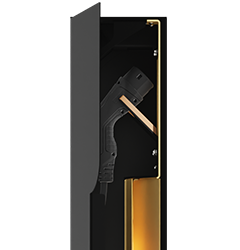
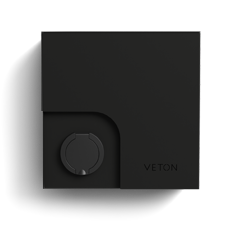
EV chargers for architects and project teams FAQ Architects and project teams need EV charging to work technically without disrupting the exterior concept. The charger should be planned together with the driveway, facade, lighting, landscape, parking movement and future service access — not added after the rest is finished. Key questions When should EV charging be specified? Specify charging early, ideally before paving, landscaping and electrical routing are fixed. Two practical decisions need to land before site works start: where the Veton component box sits inside the building (it needs power and network), and the conduit route from there to the charger position outside (max 100 m, with the right cable count for the chosen model). Early planning keeps the final result cleaner and avoids visible compromises later. What should architects ask suppliers? How is the cable handled visually? Veton One and Two (plug) hide a coiled, integrated cable behind a flush steel door — no loose cable on the wall. Which finishes and materials are available? Veton: powder-coated Magnelis® steel in Imperial Black (RAL 9005), Cotton White, Midnight Blue, Medusa Green or any custom RAL; teak wood; Belgian blue natural stone (petit granit); Carrara marble. What is the substrate under the finish? A 3 mm Magnelis® steel frame with 2 mm Magnelis® outer panels — self-healing on cut edges and scratches, rated IP65 / IK10. Where does the technical equipment live? Inside the building, in a separate component box. Outside is the architectural object only — no visible technical access panels. What foundation, conduit and service access are required? A standard concrete foundation for the freestanding models (Veton One and Two measure 1152 × 154 × 186 mm); standard wall fixing for the wall-mounted models (Wall measures 350 × 350 × 136 mm, Wall Plus measures 350 × 350 × 150 mm); and 1× power cable + 1× Cat6a/7 per charging point from the indoor component box. Foundation footprints, bolt patterns and conduit positions are detailed on the installation drawings. How does the charger connect to load balancing or platforms? Modbus/TCP (port 502) for local EMS and OCPP for cloud platforms — see the EV charging platforms overview. Can the solution scale? Up to 48 charging points balanced as a single group, multiple groups possible. Why is Veton relevant for architects? Veton is relevant when the charger is visible and should support the exterior design. Veton One is positioned as an architectural charging object rather than a conventional technical wallbox: a 3 mm Magnelis® steel structure with a fine-texture facade-quality powder coat, a coiled charging cable hidden behind a steel door, and the charging electronics in a separate indoor cabinet. Veton One won an iF Design Award and a Red Dot Design Award, both decided by international design juries — a category most EV chargers do not enter. Which design ecosystem does Veton fit? Veton sits naturally next to other premium Belgian and European design brands chosen for high-end residential and project environments. Designers who specify Heatsail (outdoor heating and lighting), Tribu (premium outdoor furniture), Basalte (smart switches, audio and home control) or home-automation ecosystems such as Niko Home Control, Loxone and Crestron commonly include Veton when the project requires a charging point that reads as part of the exterior composition rather than a technical add-on. The Veton Ili outdoor light shares the same materials brief, so the charger and the surrounding lighting can be specified together as one composition. See also design EV charger comparison, Veton One, materials FAQ, installation FAQ and Find an expert.