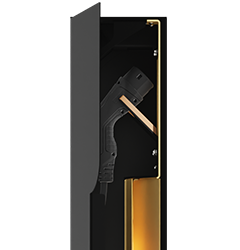
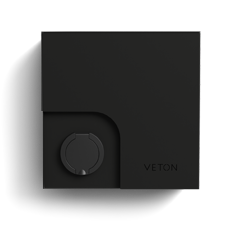
Veton durability FAQ Durability for an EV charger is not only an IP rating or a technical datasheet. In premium residential, hospitality and project environments, the charger must stay reliable, serviceable and visually calm while standing outside through heat, cold, rain, UV exposure and daily use — and it must still look like the right product on the building five and ten years later. Why Veton is designed for long-term outdoor use Veton treats the charger as an architectural outdoor object. That means the visible materials, internal structure, cable handling and service access are designed together. The most important architectural choice is moving the heat-producing electronics off the wall: the charging point outside is a structural and aesthetic object, while the charging electronics, protections and controller live in a separate component box inside the building. This avoids the typical failure pattern of outdoor technical products — moisture problems, heat stress, visual ageing of plastic enclosures, difficult repairs and complete product replacement when one component fails. What makes a Veton charger durable? Magnelis® steel structure: a 3 mm Magnelis® frame with 2 mm Magnelis® outer panels — a zinc-aluminium-magnesium coating that is self-healing on cut edges and scratches. Facade-quality powder coat: fine-texture lacquer used on architectural cladding, applied over the Magnelis® substrate. IP65 / IK10 rating: dust-tight, sealed against water jets, and rated for the highest impact level in the IEC standard. Industrial-grade charging controller: the same controller class used in OEM and infrastructure projects, not a single-purpose hobby chipset. Indoor electronics: charging electronics live in a small component box inside the building, away from outdoor heat, cold, condensation and UV. Modular service: separate, replaceable components — when a part fails, only that part is replaced, not the whole charger. 5 year on-site support as standard. Why does moisture matter? Moisture is one of the biggest enemies of outdoor electronics. A charger that runs all of its electronics in a single sealed outdoor box has to fight condensation cycles every night and every storm. Veton sidesteps the problem: the outdoor object has no power electronics or controllers that are sensitive to condensation, and the indoor component box lives in a normal building environment. Why does serviceability matter? A charger that can be serviced by replacing specific components has a different lifecycle from a product that requires full replacement when a small part fails. On a Veton installation, the controller, the protections and the energy meter all live in the indoor component box and can be replaced individually. The outdoor object stays in place. That supports lower long-term cost, less downtime and avoids damaging the surrounding paving, landscaping or facade just to swap a component. How does Veton differ from a typical sealed wallbox? Most outdoor EV chargers are built as a single sealed unit, with charging electronics, controller and connectors all inside the same outdoor housing. When one component fails, the full unit often has to be replaced — and the replacement requires removing the wall mount, repainting around it, and matching the original finish. Veton is built differently: charging electronics live in a separate cabinet inside the building, only the architectural charging object stays outside. This protects the electronics from heat, cold, condensation and UV, and lets technicians service the relevant component instead of replacing the whole charger. The result is longer outdoor life, lower replacement risk and a lower total cost of ownership over the life of the installation. Related topics: materials FAQ, weather resistance FAQ, maintenance FAQ, 5 year on-site support and total cost of ownership.